

What Is a Medical Esthetician? A Newport Beach Care Guide

If you have searched what is a medical esthetician, you may be trying to understand who can help you choose between professional skin care, a facial, or a medical aesthetic treatment. A medical esthetician is a skin care professional who works in a medically oriented setting or alongside a clinical aesthetics team. Their role often includes skin education, observation, treatment preparation, aftercare guidance, and helping you understand which questions belong with a licensed medical provider. The role matters because skin care choices are easier when you understand who is doing what, what the limits are, and what the next step might be.
What is a medical esthetician?
A medical esthetician focuses on the health, appearance, and daily care of the skin within the scope of their training and license. Depending on the practice, their work may include customized facials, skin observation, ingredient education, home-care guidance, treatment preparation, and post-treatment instructions. They may also help a client organize concerns before a clinical consultation.
The title can be used in different settings, and it is helpful to know whether the esthetician works independently or as part of a medical team. At OC Skin Care Center in Newport Beach, Orange County, care is built around your individual needs rather than a fixed menu. If you are looking for a local setting, consider how a medically oriented practice supports both skin education and professional treatment planning.
How is a medical esthetician different from a general esthetician?
The main difference is the setting and the scope of work. A general esthetician often works in a spa or salon and focuses on cosmetic skin care, facials, and product guidance. A medical esthetician often works in a medical practice and supports clinical skin care, treatment preparation, and aftercare. The training and licensing for both roles follow state requirements, and the exact scope of practice depends on the state where the work is done. Use the comparison below to see how the roles differ in general terms.
| Question | General skin care setting | Medical aesthetics setting |
|---|---|---|
| What is the primary focus? | Relaxation, cosmetic appearance, and skin care routine | Skin health, treatment preparation, and aftercare |
| Who typically leads the care? | A licensed esthetician | An esthetician working with a licensed medical provider |
| What type of treatment is included? | Facials, cosmetic skin care, and product guidance | Clinical skin care, facials, and support for medical treatments |
| What should you ask about? | Products, routine, and skin care goals | Training, scope of practice, and how care is coordinated |
The difference is less about the person and more about the setting. If you are choosing a practice, ask who will provide care, what that person's license covers, and how the practice coordinates skin care with medical treatments. You can learn more about the OC Skin Care Center team page or the services page.
What does a medical esthetician do during a consultation?
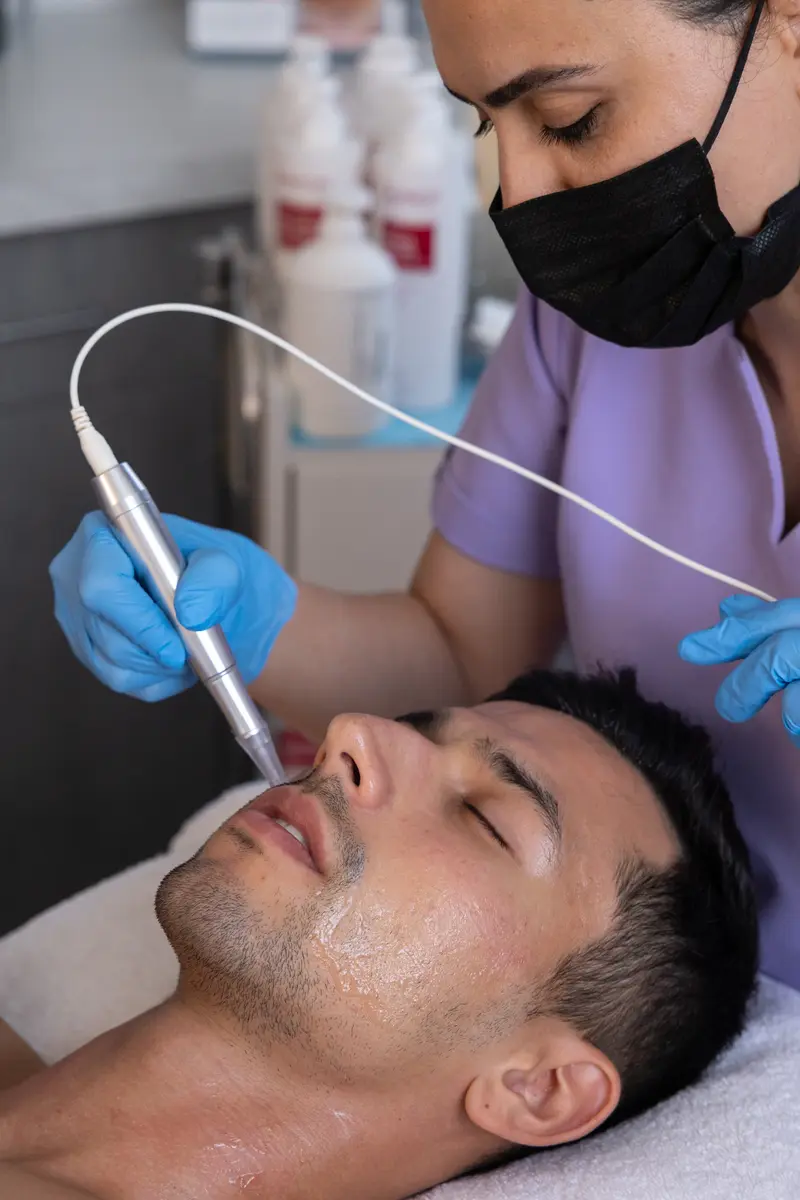
An esthetician often begins by asking what concerns you most. Common examples include dryness, sensitivity, dullness, uneven texture, breakouts, or the appearance of fine lines. A careful consultation may include the following steps:
- Clarify the concern. “I want my skin to feel less tight,” “I want to understand options for expression lines,” or “I am unsure whether I need a facial or an injectable consultation” are useful starting points.
- Review your routine. Your esthetician will ask about your current products, how often you use them, and what changes you have noticed.
- Observe your skin. They may look at tone, texture, hydration, and sensitivity. They may also ask about recent reactions or changes.
- Discuss your goals. You can describe what you hope to change and how much change you want to see.
- Explain the plan. They may suggest a facial, a skin care routine, or a conversation with a licensed medical provider if your concern needs medical evaluation.
- Talk about aftercare. They should explain what to do after a treatment and how to follow up if you have questions.
This conversation may involve a professional treatment plan or a home-care routine. For a local overview, see the practice's facials in Orange County page or the dryness and sensitivity guide.
How do wrinkle relaxers work?
A wrinkle relaxer such as Dysport & Jeuveau is an injectable neuromodulator made with a purified protein that affects communication between nerves and selected muscles. That is why a qualified injector may use it to soften the appearance of certain expression lines, such as frown lines, forehead lines, and crow's feet. The formulation also includes inactive ingredients, so the full ingredient information and your health history should be reviewed with the medical provider before treatment.
Knowing how a wrinkle relaxer works answers only one part of the larger question. A responsible appointment should also cover the area being considered, the reason it may fit your goals, alternatives, possible temporary effects, and aftercare instructions. A wrinkle relaxer is not a facial, a resurfacing treatment, or a replacement for daily skin care.
Expression lines develop in part through repeated muscle movement. A wrinkle relaxer works on the muscle activity behind those lines, while skin care works on the skin's surface. For a local overview of the injectable pathway, visit Dysport & Jeuveau in Newport Beach.
How does skin care relate to wrinkle relaxers?
Skin care and wrinkle relaxers address different parts of the overall picture. A consistent routine supports the skin's surface: cleansing, hydration, sun protection, and any active ingredients suited to your skin. A wrinkle relaxer works at selected muscles beneath the skin. One does not automatically make the other unnecessary. Some people combine a facial routine with an injectable consultation, while others focus on one or the other based on their concerns.
If expression lines are the central concern, a qualified injector can discuss whether a neuromodulator is worth considering. The choice should depend on your anatomy, goals, and preferences rather than on a single procedure. You can also learn about the practice's injectable treatments, chemical peels, or Meta Therapy microneedling.
How can you prepare for a medical esthetician appointment?
Preparation helps you get the most from an appointment. Bring information that helps the professional understand your starting point.
- Write down your main concern and what you would like to look or feel different.
- List current products, including active ingredients, sunscreen, and products used only occasionally.
- Note allergies, sensitivities, medications, supplements, and recent skin reactions.
- Record recent facials, peels, microneedling, injections, or other procedures.
- Share the timing of travel, celebrations, photographs, or other events that may affect your schedule.
- Bring questions about alternatives, aftercare, expected changes, and when to follow up.
It can also help to bring a few photos of your routine or the products you use. Avoid changing everything immediately before the appointment, because a sudden change may make it harder to discuss what is actually helping or irritating your skin. If you are unsure whether a concern belongs in an esthetic consultation or with a medical provider, say so when booking.
What should you ask before choosing a medical esthetician?
Good questions help you understand both the care and its boundaries. Consider asking the following:
- What license and training does the professional hold?
- Which parts of my concern can be addressed through esthetic skin care?
- When would I need to speak with a licensed medical provider?
- Who will perform an injectable treatment, if one is discussed?
- What products, procedures, or combinations may be unsuitable for my skin?
- What should I pause before treatment, and what aftercare should I follow?
- How will we decide whether the plan is helping?
- What alternatives exist if I do not want an injectable or advanced treatment?
You can review the practice's appointment policies before booking.
How do you choose between a facial and an injectable consultation?
A facial focuses on the skin's surface. It may include cleansing, exfoliation, hydration, or another treatment designed to improve the feel and appearance of the skin. An injectable consultation focuses on whether an injectable treatment is appropriate for your concerns. The conversation should explain what an injectable can and cannot do, what the possible effects are, and what follow-up may be needed.
If you are unsure which one you need, describe your concern in plain language. “My skin feels tight,” “I want to understand options for expression lines,” and “I am unsure whether I need a facial or an injectable consultation” are all useful openings. The complimentary Skin Roadmap can also help you organize questions before speaking with the team.
At OC Skin Care Center, a consultation may involve a medical esthetician, a licensed medical provider, or both, depending on the concern. The practice's personalized approach means the plan is shaped around your skin, your goals, and your comfort with the options.
Learn more and book a service to begin the conversation.
Frequently asked questions
Is a medical esthetician a doctor or nurse?
No. A medical esthetician is a skin care professional who works within the scope of their training and license. They are not a physician or nurse, and they should not diagnose conditions or prescribe medication. If your concern needs medical evaluation, they should direct you to the appropriate provider.
Can a medical esthetician give injectable treatments?
Do not assume that the title permits injections. Injectable treatments should be evaluated and performed by an appropriately qualified medical provider under the rules that apply where you live. Ask who will perform the treatment and what credentials they hold.
Is a wrinkle relaxer the same as a facial?
No. A facial is a skin-focused service that may address cleansing, exfoliation, hydration, or other surface-level concerns. A wrinkle relaxer is an injectable neuromodulator used in selected areas to affect muscle activity. They require different evaluations and should not be treated as substitutes.
What should I bring to my first consultation?
Bring a list of your products, including active ingredients, and note any allergies, sensitivities, or recent reactions. It can also help to share your goals in plain language and bring questions about what the plan involves.
How do I choose between skin care and an injectable consultation?
Start by describing the concern. If the issue is mainly about the skin's surface, a facial or skin care plan may be the next step. If the issue involves expression lines or volume, an injectable consultation may be more appropriate. A provider can help you decide which path fits your situation.
Understanding what a medical esthetician does—and how wrinkle relaxers work—can help you ask better questions, compare options calmly, and choose care that fits your skin and your goals. If you are in Newport Beach or the surrounding Orange County area, describe your concern in plain language when you contact the practice. “My skin feels tight,” “I want to understand options for expression lines,” and “I am unsure whether I need a facial or an injectable consultation” are all useful openings.